Case studies
What changed, and how we know
Six engagements, each reported the same way: the situation, the approach, the result, and the evidence behind the result. Where a cohort was measured, the numbers are here including the ones that complicate the story.
01 · Kingston, Jamaica · July 2026
When the class already knows a lot

Situation
A 2024 on-site assessment recommended instructor development for the Jamaica Constabulary Force. Two years later PADF brought me in to deliver it at the National Police College of Jamaica — twenty-four training staff of varying ranks, drawn from the Crime Portfolio Division and the Marine Division. Unlike a recruit cohort, these were experienced people who already knew a good deal about instruction. That changes both the design and the measurement.
Approach
Five days, co-taught with Dr. Paulette Feraria, Curriculum Consultant for the JCF. Presentation skills built iteratively across the week rather than front-loaded. Three adult learning theories taken in depth — andragogy, cognitive load theory, the Socratic method — each applied immediately to participants' own teaching. Facilitation practised live on the real obstacles to applying theory inside the JCF. Cathy Moore's "is it training?" flowchart used to analyse actual training gaps in the force, then ADDIE and curriculum development to show how course-level design scales.
Results
Every participant passed the post-test. The cohort moved from 53.8% (7 of 13 items) to 92.3% (12 of 13) — 38.5 percentage points. But because they started from a strong baseline, raw gain understates the effect. Hake's normalized gain measures learning against the improvement actually available to a group, and the cohort scored 0.83: they captured 83% of the distance between where they started and a perfect score. That sits in the high-gain band associated in the literature with interactive-engagement instruction rather than lecture.


It is clear that Ben is a master facilitator. Just by his presence facilitating I was able to gain new skills.
JCF participant, National Police College of Jamaica
Learning was taking place every day, and participants will benefit greatly, and the organization at large will improve greatly in the delivery of service to Jamaica.
JCF participant
The complicating note
One hundred percent rated the training great or excellent, and the most consistent piece of constructive feedback was that they wanted more: specifically, deeper training on full-scale curriculum development and ADDIE. That's the correct outcome for a foundation course — participants left with the vocabulary and confidence to begin designing instruction, and are now positioned for the harder systematic work. It is also a real gap, and the recommendation on record is an advanced curriculum development course for NPCJ and divisional training staff.
02 · Nassau, The Bahamas · Spring 2024
From under 10% to 81% in five days
Situation
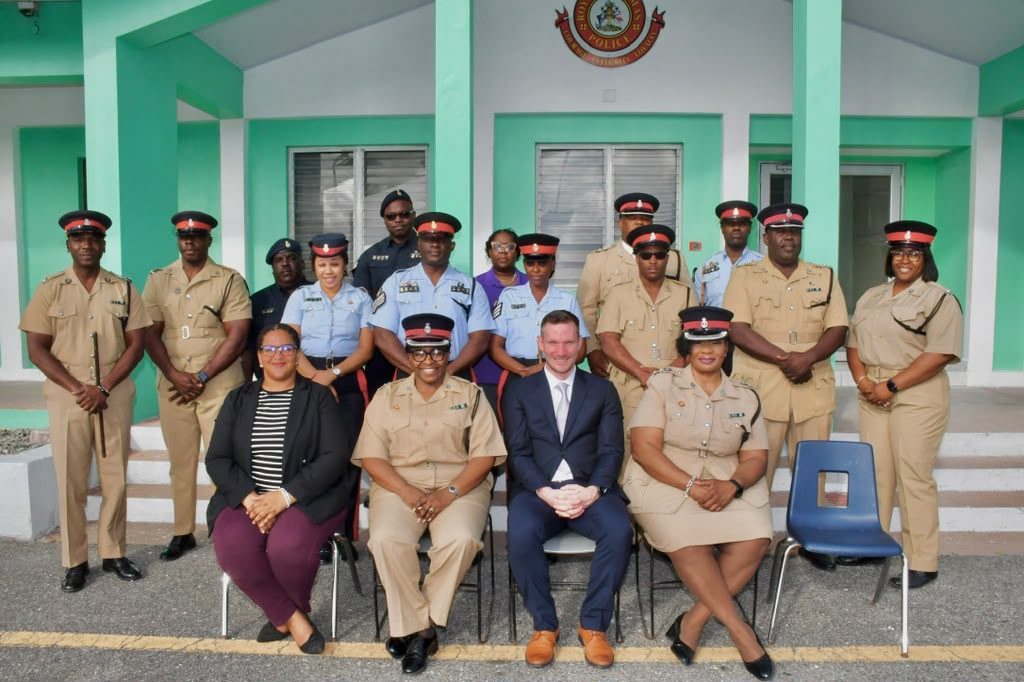
An on-site needs assessment in Nassau identified a foundational gap: Royal Bahamas Police Force training staff were teaching without formal grounding in instructional design. PADF commissioned a five-day course at the Training College for eighteen participants of varying ranks.
Approach
The same five-day architecture — presentation skills, adult learning theory, facilitation, feedback, and backwards instructional design — but tuned to a cohort with almost no prior exposure to the material. The teaching methods deliberately modelled the principles being taught, which participants noticed and named repeatedly in their feedback.
Results
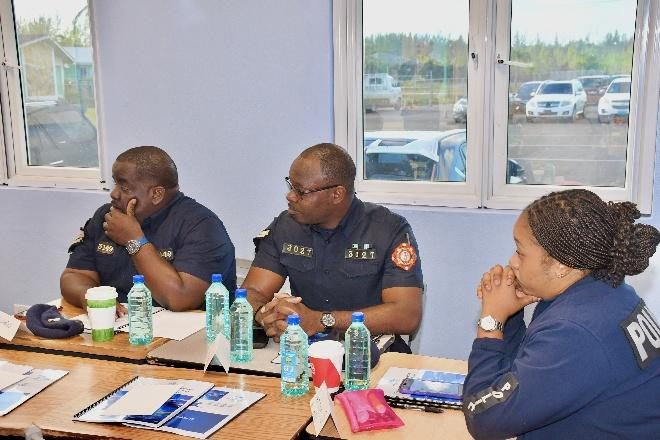
Participants averaged below 10% on the pre-test and 81% on the post-test. All eighteen passed the final project — a co-taught 25-minute lesson — teaching topics including fire extinguisher use, handcuffing, rank structure and law. Their work demonstrated command of the Socratic method as an instructional tool, cognitive load management, objective development, and course sequencing.
This is one of the best courses I've ever been on in my 22 years of policing.
RBPF participant with 22 years' service
The material presented gave all of the why's to an assignment we as trainees have been doing for so long without proper instructions.
RBPF participant
The complicating note
Across eleven feedback surveys, one participant raised a substantive developmental point: set participation expectations and conduct standards earlier, and project more authority when working across rank and cultural lines. That's a fair note on leading law enforcement training as an outsider, and it changed how I open a course.
03 · Guyana Police Force · Fall 2023 · Curriculum development
One course, two ranks, two curricula
Situation
Under Strengthening Guyana Police Force Training to Improve Responses to Vulnerable Populations — a PADF programme funded by the U.S. Department of State's Bureau of International Narcotics and Law Enforcement Affairs — the Guyana Police Force needed officers to handle crisis encounters with vulnerable people differently.
The obvious move is to write one course and teach it to everybody. It's also the wrong move. A senior commander and a frontline supervisor need different things from the same subject: the commander sets policy and reviews incidents after the fact, the supervisor is on scene while it happens. Teach them identical material and half the room is being trained for someone else's job.
Approach
Two parallel ten-module curricula built on a shared spine, then deliberately forked by audience. Both cover leadership, procedural justice and legitimacy, emotional regulation, crisis communication and police wellness. From there they diverge:
- Senior leaders get after action reviews and tabletop exercises — the tools of someone accountable for how the organisation responds.
- JOC Academy supervisors get incident debriefing and case studies — the tools of someone in the room when it goes wrong.
Co-authored with Jason Jones and Thomas Datro, then co-taught as a training of trainers for fourteen officers, so the GPF could carry the material forward without us.
Design decisions worth naming
The reflection block
Every module closes with the same four prompts — what you got, what you want more of, what you need to succeed, and open notes. Repeated ten times, it stops being a worksheet and becomes a habit. It also hands the instructor a live read on where the room actually is, module by module, instead of a single end-of-course survey delivered too late to act on.
Handbook as working document
Slides on the left, note space on the right, throughout. Participants leave with a filled-in reference rather than a printout of someone else's presentation — which is the difference between a handbook that gets used in the field and one that goes in a drawer.
Recruit academy alignment
Both curricula include a module walking leaders through what recruits are currently taught. Supervisors can't reinforce standards they've never seen, and vertical alignment across an academy is the cheapest quality gain available to most forces.
04 · Portland, Oregon · 2022 — present
Building the system, not just the course
At the Portland Police Bureau the problem was never a single bad class — it was variance. Instruction quality depended on who happened to be teaching. The answer was infrastructure: a standing instructor development programme of fifteen multi-modal courses that has now certified 358 personnel, spanning sworn officers, behavioural health clinicians and administrative specialists.
Alongside it, a department-wide quality assurance programme anchored by 194 formal training observations, giving the division an actual evidence base for curricular fidelity rather than an impression of it. And a standardised lesson plan schema so that consistency is built into the format instructors write in.
More recently, AI integration in recruit training — crisis simulators, automated analysis of survey feedback, and performance tracking tools that shorten the loop between an observation and an instructor acting on it.
By the numbers
Roles reached span sworn officers, behavioural health clinicians and administrative specialists — a deliberately wide net, because a training division that only serves patrol leaves most of the organisation untrained.
05 · Global · 2019 — 2022
Training at the scale of an international NGO
Catholic Relief Services needed core software adoption training that would work equally well for a finance officer in Baltimore and a field team in Upper Egypt. The design constraint was not complexity but portability: material that survives translation into ten languages and lands in twenty-three national contexts without being rebuilt each time.
Separately, as Acting Program Manager, I managed roughly one million US dollars in peacebuilding and partnership programming across Cairo and Upper Egypt — the operational counterpart to the design work, and a useful corrective. It is harder to write unrealistic training plans once you have had to fund and staff them.
Reach
06 · Sittwe, Rakhine State, Myanmar · 2018 — 2020
Human rights education across a hard divide
Human rights curricula delivered to more than 140 Rakhine and Rohingya youth in Sittwe and in Rohingya IDP camps — two communities separated by active conflict, taught the same material. The design question was how to teach universality without erasing the specific grievances each group brought into the room, which is also the subject of the paper I published on the work through Columbia.
The programme was built to outlast me. An on-site training of trainers certified local instructors to deliver the curricula themselves, which is the only version of this work that means anything after the consultant's flight home.
Reach
Published as Centralizing Universality in Human Rights Education for Rakhine State, Myanmar, Columbia University, 2018.
Your agency's version of this
Every one of these started with a conversation about what people needed to be able to do.